
EMS FLEET & PROCUREMENT GUIDE
Type 1 vs. Type 2 vs. Type 3 Ambulance: What's the Difference?
Type 1 vs type 2 vs type 3 ambulance classifications describe chassis configuration, not the level of medical care a unit can provide. A Type 1 rides on a full truck chassis, a Type 2 is an integrated van, and a Type 3 combines a walk-through module with a van-cutaway frame. The distinction matters most at remount time: Type 1 and Type 3 modules are separable from their chassis and can be transferred to a new chassis, while a Type 2’s compartment is built into the van body itself.
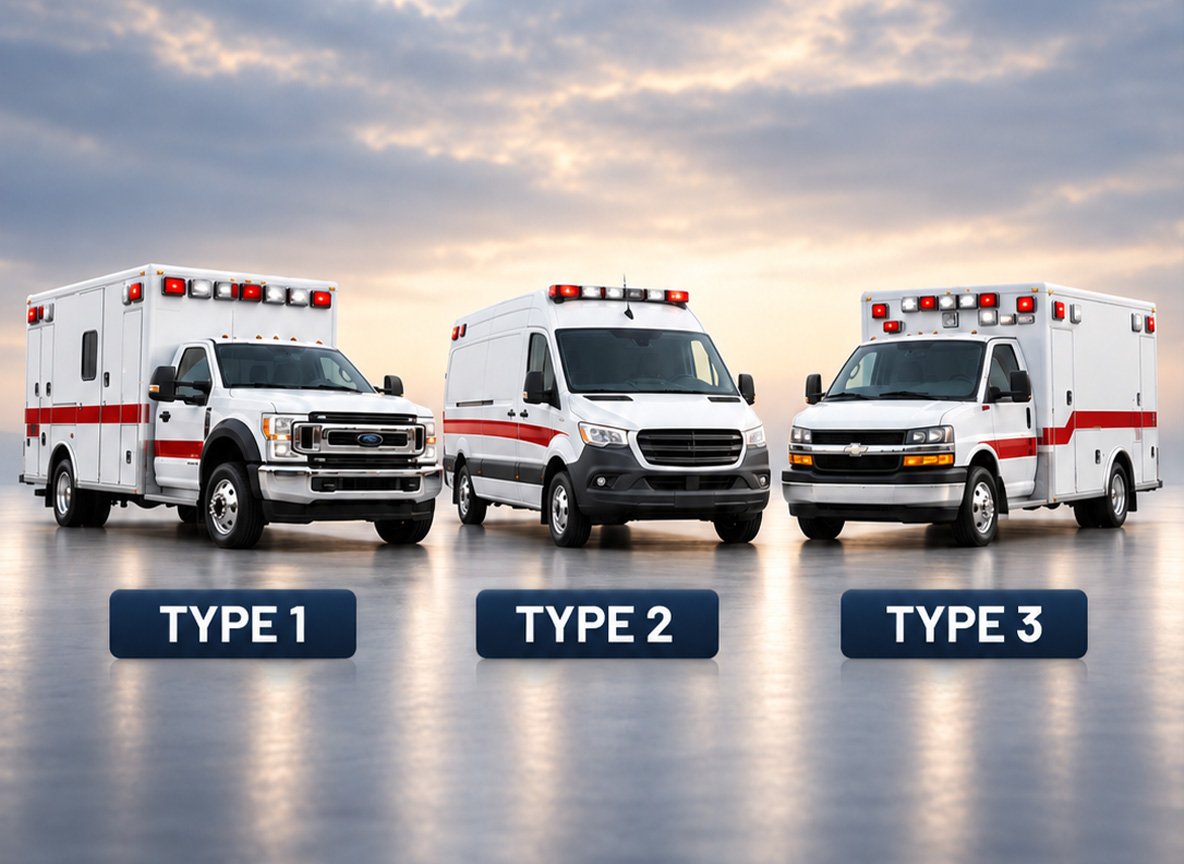
The three types at a glance
Type 1
Truck chassis
Chassis: Ford F-450/550, Ram 4500/5500
Build: Separate cab, walk-through to module
Best for: Heavy patient loads, rough terrain, rural/critical care
Remountable: Yes — standard candidate
Type 2
Van (integrated)
Chassis: Mercedes Sprinter, Ford Transit
Build: Raised roof, no separate box
Best for: BLS transport, lower cost, better fuel economy
Remountable: Rarely — not separable
Type 3
Van-cutaway chassis
Chassis: Ford E-450 cutaway
Build: Walk-through module on cutaway frame
Best for: Urban/suburban EMS — space & maneuverability
Remountable: Yes — standard candidate
Why the type matters for a remount decision
Type 1 and Type 3 dominate the remount market for a structural reason — the module is built to outlast the chassis underneath it.
| Factor | Type 1 | Type 2 | Type 3 |
|---|---|---|---|
| Module separable from chassis | Yes | No | Yes |
| Typical remount chassis | Ford F-450/550, Ram 4500/5500 | — | Ford E-450 |
| Ground clearance / off-road | Highest | Lowest | Moderate |
| Fuel economy | Lowest | Highest | Moderate |
| Typical fleet role | Rural, heavy-duty, critical care | Urban BLS, low-mileage transport | General-purpose urban/suburban EMS |
The standards that actually govern ambulance builds
Three names come up regardless of type — knowing which one applies matters when evaluating a remount quote.
Retired federal spec
KKK-A-1822F
The original federal ambulance specification. Still referenced on older units, but superseded — don’t quote a remount against this standard alone anymore.
Current standard
The active standard for automotive ambulances. This is the baseline any remount should meet — see the full explainer.
Newest benchmark
The most rigorous current safety benchmark. See CAAS GVS certification to check if your remounter builds to this spec.
Common Questions
Does the ambulance type affect the level of medical care it can provide?
No — Type 1, 2, and 3 all refer to the chassis configuration, not the equipment or certification level inside. A Type 2 van can be fully ALS-equipped; the type just describes what it’s built on.
Can a Type 2 ambulance be remounted?
Rarely. Because the patient compartment is integrated into the van’s body rather than a separate module, there’s typically nothing to transfer to a new chassis — most Type 2 units are replaced outright rather than remounted.
Which type is most common for a remount project?
Type 1 and Type 3 make up the vast majority of remount work, since both use a separable module built to outlast two or three chassis lifecycles — the entire economic case for remounting depends on that separability.
Which ambulance type is best for urban EMS?
Type 2 and Type 3 are generally preferred in dense urban environments for their smaller footprint and better fuel economy, while Type 1’s larger size and payload capacity favor rural and heavy-duty rescue work.
What’s the difference between NFPA 1917 and CAAS GVS v2.0?
NFPA 1917 is the current baseline standard for automotive ambulances. CAAS GVS v2.0 is a newer, more rigorous voluntary benchmark on top of that baseline — a remount can be built to meet either, but GVS v2.0 compliance is worth confirming explicitly with your remounter.