
EMS FLEET & PROCUREMENT GUIDE
What Does an Ambulance Remount Cost?
Ambulance remount cost typically runs $90,000 to $180,000 — a 30–50% savings against a comparable new-build unit, which now commonly prices between $200,000 and $400,000 fully equipped. The math is straightforward: a remount reuses the most expensive fabricated component, the patient module, instead of building one from scratch. For EMS fleet managers facing 24-plus month wait times on new orders, that combination of lower cost and faster turnaround has made remounting the default budget strategy rather than a fallback option.
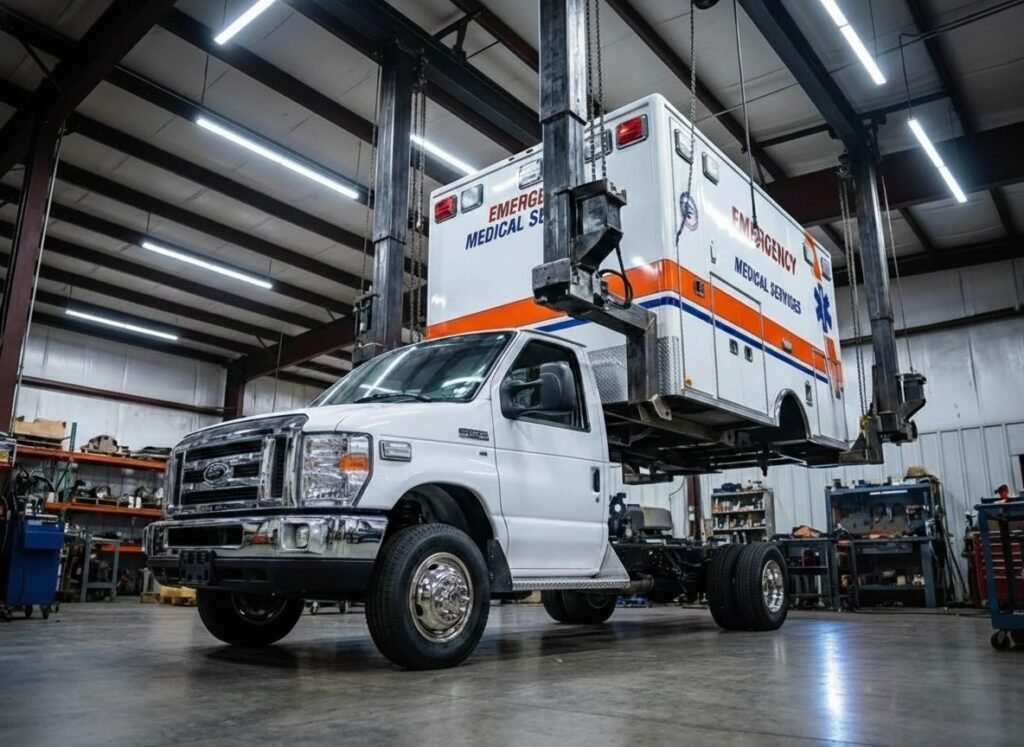
What a remount actually includes
The four stages that run on every unit — built around the chassis you choose.
1. Demount & inspection
The module is disconnected from the old chassis and the sub-frame is inspected for stress cracks, corrosion, or fatigue before any work is quoted.
2. Chassis preparation
New chassis (F-450/550, Ram 4500/5500, or Chevy) is modified for wheelbase, pass-through bellows, and often upgraded to Liquid Spring suspension. See the full chassis guide.
3. Electrical & HVAC overhaul
Old wiring — the leading cause of ambulance failure — is replaced with modern multiplex systems; condensers, evaporators, and hoses are reworked.
4. Cosmetic restoration
Module is sanded, painted to match the new cab, and re-graphic’d to current department branding — indistinguishable from a new unit.
Optional safety upgrades
LED warning lights, antimicrobial non-slip flooring, 4/6-point harnesses, Stryker Power-LOAD or Ferno cot systems, airbag retrofits.
Remount vs. New Build
| Factor | Remount | New Build |
|---|---|---|
| Typical cost | $90,000–$180,000 | $200,000–$400,000 |
| Lead time | 90–120 days | 24+ months (current market) |
| Chassis | New — resets drivetrain lifecycle | New |
| Box / module | Existing module reused — crew already knows the layout | Built new |
| Best fit | Module structurally sound, engine/chassis worn out — see is my ambulance a candidate? | Module has severe corrosion, accident damage, or is obsolete |
Who's actually doing the work
Remount quality varies a lot by shop. Check for these before you sign a quote — or see how to vet one on our remount companies guide.
Ford QVM
Qualified Vehicle Modifier status — meets Ford’s own engineering benchmarks. See Ford QVM explained.
CAAS GVS
Ground Vehicle Standard listing for ambulances — see CAAS GVS certification.
Ambulance Manufacturers Division of NTEA — shop participates in setting industry standards, not just following them.
EVT-Certified Techs
Emergency Vehicle Technician certification — see what is an EVT?
Common Questions
How much does it cost to remount an ambulance?
Remount shops such as FleetPlus and its Texas dealer TRES report savings of roughly 30–50% versus buying a comparable new-build unit — driven mainly by reusing the existing patient module instead of fabricating one from scratch. Multiple national remount providers (Axiant, Elite Ambulance Sales, North Central Emergency Vehicles) independently confirm remounts running $90K–$180K against a $200K–$400K new build.
Is remounting an ambulance cheaper than buying new?
Yes. Because the module — the most expensive fabricated component on the vehicle — is refurbished and reused rather than rebuilt, remounts run well below new-build pricing while still resetting the chassis, electrical, and HVAC systems.
How long does an ambulance remount take?
Typically 90 to 120 days at a dedicated remount shop, compared with 24+ months for a new ambulance order in the current market — confirmed independently by TRES, Elite Ambulance Sales, and Haloid Solutions.
Is my ambulance a candidate for a remount?
The deciding factor is the module’s structural condition, not its age. If the box has severe corrosion, accident damage, or an obsolete layout, retiring it makes more sense. If the box is solid and it’s the engine or chassis that’s worn out, a remount is generally the better financial move.
How much does a new ambulance cost in 2026?
Current market pricing for a new-build Type I, II, or III ambulance commonly runs $200,000–$400,000 fully equipped, per multiple 2026 industry financing sources — which is the baseline remount savings are measured against.
Related guides on this site
Companies
Manufacturers